Art of Nature
Meet local ikebana expert MaryLee Hawse
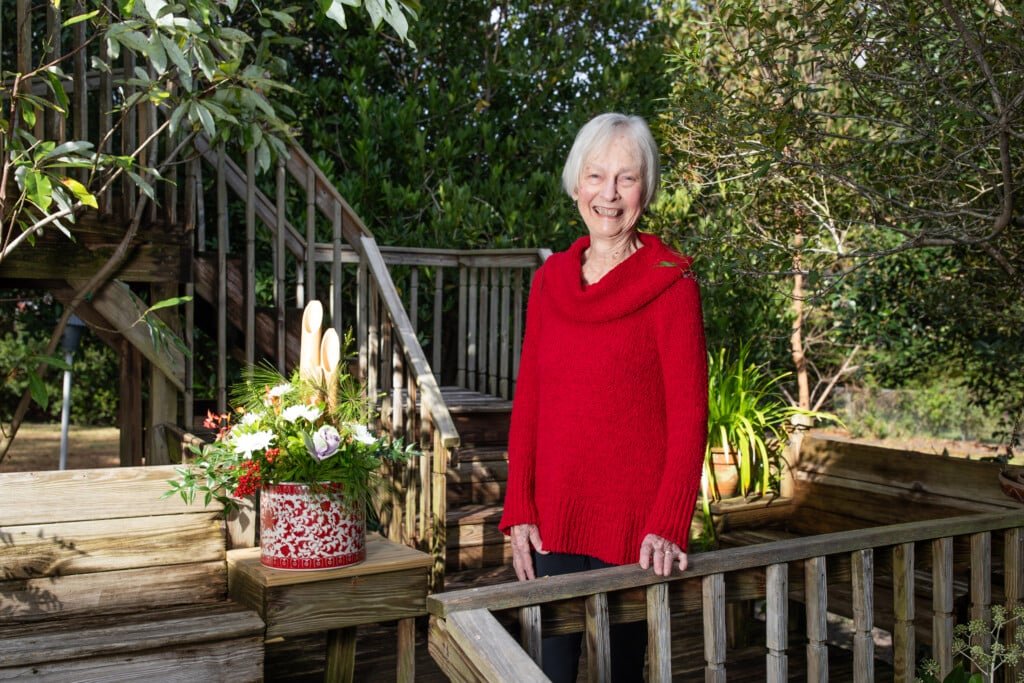
Whether her landscape consists of a slender vase or the broad reaches of her yard, MARYLEE HAWSE brings a love of nature to her work.
A large part of Hawse’s creative life is spent studying ikebana, the Japanese art of flower arrangement, which has ancient origins.
“Ikebana has been practiced for more than 600 years,” she says. “It developed from a Buddhist ritual of offering flowers to the dead and when Buddhism was brought to Japan from China in the sixth century. By the fifteenth century, ikebana had achieved the status of an art form, one of many art forms in Japan.”
Over those centuries, several different ikebana schools emerged, each with its own rules of arrangement, but they are all based on the love of nature, Hawse continues.
“They present flowers with what they call the shussho – the way the flower grows and how it expresses itself,” she explains. “They are the intrinsic, specific properties distinctive to each plant. Each plant will show you its shussho.”

A floral arrangement by MaryLee Hawse sits in her front hallway in Wilmington on December 8.
Hawse first encountered ikebana early in her married life when she and her husband, STANLEY, lived in Shepherdstown, West Virginia. When her garden club hosted a presentation on the floral art, Hawse made a mental note to learn more about it and perhaps take classes. Several years later, when Stanley’s work as a chemist brought them to Wilmington, she joined a neighborhood garden club and met fellow ikebana enthusiast BONNIE BURNEY, “and things just grew from there,” she says. A group from the club formed an Ikebana study group in the late 1970s and formed Chapter 212 of Ikebana International in 1979. It became chartered in 1981, with sixteen members.
Over the years, the Wilmington Ikebana chapter has hosted guests from Japan who have demonstrated various aspects of that country’s culture, from weddings to tea ceremonies to Noh drama, the oldest surviving form of Japanese musical theater. In the 2000s, club membership included six Japanese women whose husbands were on assignment at the Castle Hayne GE Vernova Hitachi plant.
Things flourished in the Hawses’ yard as well. The couple, natives of West Virginia, grew up with an appreciation of the natural world around them.
“My husband’s home, nestled in the Lost River Valley, had been in the family since 1848,” she says. “We could roam through the woods and mountains, which was one of my favorite things to do.”
When the two moved to Wilmington, they built a home in the recently developed Landsdowne neighborhood. Their lot was surrounded by woods.
“The children just loved it,” she says of their three boys.
With very fond memories of their West Virginia roots, the Hawses wanted to recreate some “almost heaven” in their own back yard. They started with rocks.
“We started bringing rocks back from West Virginia,” she recalls with a laugh. “We wanted to build a small pond in our back yard near the deck. We have lots of funny stories and memories about those rocks, but we finally got the pond built.”
Making a yard into a true garden has taken years of love and effort, starting with the deck and pond.
“We tried to grow things that do well in North Carolina, and we did the natural things: a lot of myrtle bushes and a shade garden. We started with some ivy and let it go on one side of the yard, then shaped it,” Hawse says.
Their gardenscape includes oaks, tallow trees and magnolias.
“It’s huge, but a constant cleanup job,” Hawse says of the magnolia tree she and her husband planted early-on. “Magnolias give you gifts all year long.”
They designed their driveway to curve around the yard’s stand of pine trees.
Later came a Japanese cherry tree, holly bushes, a sasanqua camellia, and two chestnut trees the couple brought back from West Virginia. They also built a treehouse for the boys, wrapped around the tree itself.
“Our three sons and five grandchildren loved that treehouse,” Hawse says. “All were creative, and the treehouse became different spaces for them.”
There have been fatalities. The chestnut trees fell prey to a hurricane. Through the years, all the pines have died, leaving an inexplicably curving approach to the house.
“Everybody hates our driveway,” she says with a laugh.
The latest storm victim was the treehouse tree, whose top snapped off during a recent mini-tornado.
When she’s not tending her extensive outdoor landscape, Hawse is enhancing her understanding of ikebana and honing her skills. She and several others in her chapter follow the Ikenobo school of ikebana, but there are others, of which the best known are Ohara and Sogetsu. Each has its own techniques, styles, philosophies, and grand masters. Hawse herself has earned fourteen ikenobo certificates and is now a first-grade (top) professor, entitled to teach the ikenobo way to others.
“It’s been a lifetime goal, so here we are!” she says. “But you never stop studying.”
Learn more about the Wilmington chapter of Ikebana International at ikebanahq.org/archives/activities/wilmington-chapter-212.
To view more of photographer Madeline Gray’s work, go to madelinegrayphoto.com.
Want more WILMA? Click here to sign up for our WILMA newsletters and announcements.
